Podcast Episode 10

Talking knives with Ben Orford.

For the 10th instalment of the Urban Bushcraft we venture out to Malvern to interview Ben Orford and talk about knives, get tips on getting started with making knives and Ben’s first trips into London. We also have a contest to win a Ben Orford t-shirt and the winner will be announced on the next show.

Ben_Orford

Links:
Ben Orford
Ben’s YouTube channel
Step-By-Step Knifemaking: You Can Do It! by David Boye
Bushcraft and Survival Skills Magazine
The Bushcraft Show

Download via iTunes OR Via our Feed

Posted in Podcast | Leave a comment

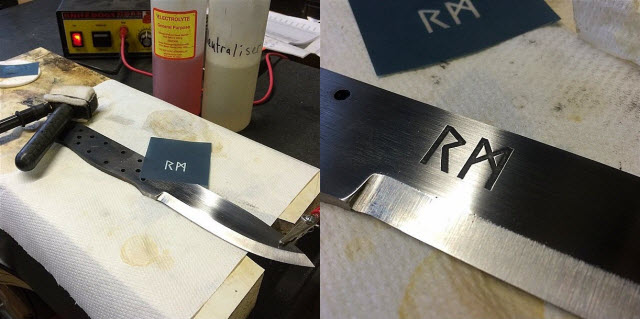
Making a Bushcraft Knife – Part 2

Once I had settled on the design of my knife the next task was to turn it from bar stock into a blank ready for heat treatment, I was given a disc/belt grinder sander combo and was looking for a place I could set it up as I do not have the space at home. Then Mark arranged for us to interview Ben and Lois Orford at their workshop in Herefordshire, so I brought my bit of steel along just in case we had some time to play in the workshop.

ben_orfords_workshop

As it so happened we had some time after lunch and with Ben’s guidance I set about trimming the stock close to shape using a band saw, which after tweaking the design a few times since I first drew it on was a big step as once you take the material off you cannot put it back on. A few minutes later I was holding a crudely shaped version of my knife, next was to refine it using various grits on the radius master grinder.

bushcraft_knife_stage2_bandsaw

This was actually a therapeutic process watching the curves form and blending them together, all the time paying attention to make sure I did not catch my knuckles on the belts whizzing by. This was the first knife blank to be ground out on the grinders in the new extension to Ben’s workshop, perhaps we should have cut a ribbon and declared the extension officially open first?

bushcraft_knife_stage2_grinder

Next up was a mini masterclass on where to drill the holes for fixing the scales and lanyard tube, we also scribed the bevel markings at the same time. I was thinking of tapering the tang to keep the weight down in the handle but after drilling some holes for the epoxy to bond through, I found that the handle was light enough. Which will make things easier in the later stages of creating this knife.

bushcraft_knife_stage2_drill

The final thing of this stage was to grind the bevel, Ben made a few passes to show me the technique then handed the knife to me. I made a few passes and then checked to see how much material was removed, it was a case of trying to maintain the same angle each pass and making sure you work to the scribed lines. I do not think I did a bad job for my first time and Ben kindly tidied up the bevels to give them a smoother finish.

bushcraft_knife_stage2_complete

The next step will be to heat-treat my blade.

Posted in Cutting Tools, Projects | Leave a comment

Bushcraft and Survival Foundation Course (1 Day) – Frontier Bushcraft

On Easter Monday I attended the Bushcraft and Survival Foundation Course run by Frontier Bushcraft having won a place in a competition Paul Kirtley had run on twitter.

Frontier_Bushcraft

I arrived at the meet point stated on the joining instructions and sorted out my layers having shed some on my walk from the train station. It was here that I met Matthew who is the Editor of Scouting Magazine (and also took all the photos in this article), one of his first questions were “Are you Mark or Ray?” just before we formally introduced ourselves. A few moments later Paul and James arrived to lead us to the location of the course, it felt like a secret as the group set off. Once all the cars were parked we headed off on foot for the last 5-10 minutes to the base camp in the woods, we were greeted on our arrival by the smiling faces of the rest of the Frontier Team and a kettle on the fire. After we all made a brew and did our introductions we listened to Henry give the health and safety speech, Paul then explained what we would be covering throughout the day. This was followed by a tour of the area and an exercise that I was not expecting, I won’t say what happens here to keep it a surprise in the future. Only that it has made me think and change my preparedness approach.

Image © Matthew Jones/The Scout Association

Image © Matthew Jones/The Scout Association

Next up was a session under the parachute on the priorities of survival, here Paul talked about recognising the events that can lead up to a survival situation, demonstrated his maths skills explaining search areas and pi. We were also taught two acronyms (STOP and PLAN) and the Golden Rule of Wilderness Travel: Tell a responsible person where you are going, the route you are taking and what time you expect to be back. No one will come looking for you if they do not know you are missing!

James then took the group off and demonstrated how to choose a safe location before preparing and lighting a fire using matches, I found it interesting as he talked about how he positions his body in relation to the wind and what he would do different in the rain or with other people in his group. Which was something I had never put much thought into, but will now consider the next time I come to light a fire.

Image © Matthew Jones/The Scout Association

Image © Matthew Jones/The Scout Association

We was then shown how to get the inner bark from a sweet chestnut tree and prepare it to make a tinder bundle, as it was damp it allowed we also learnt ways of making the tinder dry and ready for use either by drying near an existing fire or by hanging it in a tree for the wind to dry it out like clothes on a line.

Image © Matthew Jones/The Scout Association

Image © Matthew Jones/The Scout Association

So with our tinder drying out around the fire we split into groups and collected equipment from the stores, then went to pick up our food from the kitchen area. We then all headed off to an area next to a stream and selected a suitable area to make our own fires for cooking lunch, then prepared the site and collected our firewood. Once our fires were lit using the matches as taught by James earlier we gathered on the bank of the Stream to collect water and Paul went over the various methods of collecting, filtering and treating water to ensure it is safe.

Image © Matthew Jones/The Scout Association

Image © Matthew Jones/The Scout Association

Lunch was chorizo, tomato and haloumi cheese, the chorizo went on a green stick skewer to grill over the embers and the rest went into a pan to be fried.

Image © Matthew Jones/The Scout Association

Image © Matthew Jones/The Scout Association

To go with lunch we had a demonstration on making bread that can be cooked over the campfire from Alison, we then sat down with a brew to enjoy our creations and chatted with the team as they moved between the group checking on how we all got on.

Image © Matthew Jones/The Scout Association

Image © Matthew Jones/The Scout Association

After we had eaten lunch Henry gave a demonstration on how to ensure we left no trace that we were there and once we did the same to our own fire sites we headed back up to the main camp area and washed up.

Image © Matthew Jones/The Scout Association

Image © Matthew Jones/The Scout Association

The next item we covered was shelters and to begin with we looked at some two-man shelters that were made a few days before by participants on the Bushcraft Essentials course, we then made two different types of shelter as a group.

Image © Matthew Jones/The Scout Association

Image © Matthew Jones/The Scout Association

One for use with a fire and one for use without a fire, learning about where to build them, which direction to face them in relation to the prevailing wind and how we could make them visible in a survival situation.

Image © Matthew Jones/The Scout Association

Image © Matthew Jones/The Scout Association

Then it was back to the parachute for a brew and fire lighting methods, Paul demonstrated two different methods using different materials. He started off by showing the group how to prepare silver birch back so that the shavings could be lit using a fire steel, then it was our turn. I quickly leant the importance of trying to keep the shavings attached to the section of bark as I watched them blow away in the wind, the second time round I took more time to prepare my tinder and it paid off. Paul’s top tinder tips are:

  1. Preparation,
  2. Preparation,
  3. Preparation!

Now that our sweet chestnut inner bark bundles had dried out we started to separate the individual fibres to make the tinder bundles as fluffy as possible. Paul then demonstrated how to use flint and steel along with char cloth to create an ember which was added to the tinder bundle and gently blown into flame. This is one of my favourite fire lighting methods and this time round I was able to get a glowing ember in my char cloth within seconds, which when added to my tinder bundle soon resulted in flame.

Image © Matthew Jones/The Scout Association

Image © Matthew Jones/The Scout Association

At the beginning of the day as we went around doing our introductions I mentioned that I would like to work on my bow drill skills, while it is not normally part of the course there was a few moments spare and there was an extra bow drill from the course the day before so I was given a quick refresher and with Paul’s assistance I soon had a pile of black smoking powder. Once the ember had established itself it was added to a tinder bundle and blown into life.

Image © Matthew Jones/The Scout Association

Image © Matthew Jones/The Scout Association

The course finished up with Paul showing us what kit he packs for a trip to the woods and how he packs it, he really does pack a kitchen sink. I think this is where I can improve the most from what the course covered as I always seem to take too much when I go camping.

Image © Matthew Jones/The Scout Association

Image © Matthew Jones/The Scout Association

I thought that the day ran at the ideal pace, it was almost non-stop but I never felt rushed. Everyone from Frontier is knowledgeable and friendly, I would recommend them to anyone who is considering booking onto a bushcraft or survival course and will be looking to get myself booked onto one of Frontier Bushcraft’s other courses in the future.

Posted in Bushcraft Courses | Leave a comment

Choosing a Bushcraft Axe – Ben Orford

Posted in Cutting Tools, Products | Leave a comment

Podcast Episode 9

The Bushcraft Show is coming, The Bushcraft Show is coming.

In this episode we talk about the Bushcraft Show 2013, announce the winner of the paracord bracelet from I.E.A.T Scouts, play an audio clip from our listener and give a first impression review on the survival bracelets from Wazoo Survival Gear.

bushcraftshow2013

Links:
Bushcraft and Survival Skills Magazine
The Bushcraft Show
I.E.A.T Scouts
Wazoo Survival Gear

Download via iTunes OR Via our Feed

Posted in Podcast | Comments Off